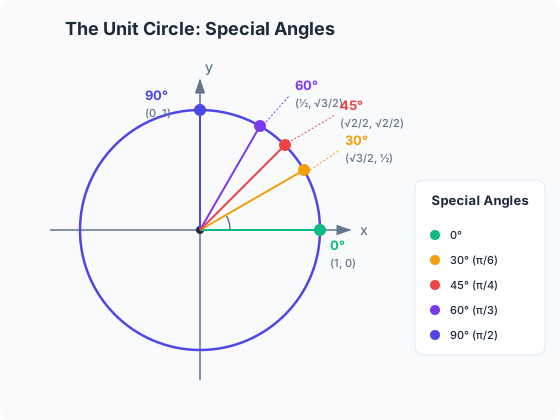
Unit Circle with Exact Values: Complete Guide
The unit circle is the single most important diagram in trigonometry. Once you understand how unit circle exact values work, every sine, cosine, and tangent problem becomes a matter of reading coordinates off a circle rather than guessing at formulas.
If you have ever struggled to recall whether sin 60° is √3/2 or 1/2, or which values turn negative past 90°, this guide will clear everything up. Below you will find every standard angle, its exact coordinates, and a straightforward method for deriving any value you need.
What Is the Unit Circle?
The unit circle is simply a circle with a radius of 1, centred at the origin (0, 0) of the coordinate plane. Its equation is:
x² + y² = 1
Because the radius is exactly 1, the coordinates of any point on the circle have a beautifully direct relationship with trigonometric functions. Every point where a ray from the origin meets the circle can be described as a pair of exact values that map straight to sine and cosine.
"Unit" just means one. By fixing the radius at 1, all of the usual scaling factors disappear and the raw trigonometric ratios are exposed. That is why textbooks and curricula in the United States, Australia, and the UK all centre their trigonometry courses around this single circle.
Why the Unit Circle Matters
Here is the key idea that makes the unit circle so powerful: for any angle θ measured from the positive x-axis, the point where the angle's ray intersects the circle is
(cos θ, sin θ)
In other words, the x-coordinate is cos θ and the y-coordinate is sin θ. This single fact replaces the need to memorise separate definitions for each function in each quadrant. If you can plot the angle on the circle, you can read off its exact values immediately.
This relationship also means that every trigonometric identity, from the Pythagorean identity (sin²θ + cos²θ = 1) to the double-angle formulas, is really just a geometric statement about coordinates on a circle of radius 1.
The Special Angles on the Unit Circle
There are 16 standard angles that appear repeatedly in courses, exams, and standardised tests. They are built from just three reference angles — 30°, 45°, and 60° — reflected into all four quadrants, plus the four axis angles (0°, 90°, 180°, 270°).
The table below lists every angle in degrees and radians alongside its exact cosine and sine values. If you are looking for a printable exact values table, we have a dedicated page for that as well.
| Angle (°) | Angle (rad) | cos θ | sin θ |
|---|---|---|---|
| Quadrant I — All positive | |||
| 0° | 0 | 1 | 0 |
| 30° | π/6 | √3/2 | 1/2 |
| 45° | π/4 | √2/2 | √2/2 |
| 60° | π/3 | 1/2 | √3/2 |
| 90° | π/2 | 0 | 1 |
| Quadrant II — Only sin positive | |||
| 120° | 2π/3 | −1/2 | √3/2 |
| 135° | 3π/4 | −√2/2 | √2/2 |
| 150° | 5π/6 | −√3/2 | 1/2 |
| 180° | π | −1 | 0 |
| Quadrant III — Only tan positive | |||
| 210° | 7π/6 | −√3/2 | −1/2 |
| 225° | 5π/4 | −√2/2 | −√2/2 |
| 240° | 4π/3 | −1/2 | −√3/2 |
| 270° | 3π/2 | 0 | −1 |
| Quadrant IV — Only cos positive | |||
| 300° | 5π/3 | 1/2 | −√3/2 |
| 315° | 7π/4 | √2/2 | −√2/2 |
| 330° | 11π/6 | √3/2 | −1/2 |
Notice the pattern: the magnitudes repeat in every quadrant. Only the signs change. That observation is the key to the quadrant rules explained next.
Quadrant Rules: The ASTC Method
Rather than memorising all 16 rows of the table above, you only need the first-quadrant values (0°–90°) and a simple sign rule. The mnemonic ASTC — often remembered as "All Students Take Calculus" — tells you which functions are positive in each quadrant:
- Q I All — sin, cos, and tan are all positive
- Q II Sin — only sine is positive (cos and tan are negative)
- Q III Tan — only tangent is positive (sin and cos are negative)
- Q IV Cos — only cosine is positive (sin and tan are negative)
This makes sense geometrically. In Quadrant II the x-coordinates are negative while y-coordinates remain positive, so cosine (x) is negative and sine (y) is positive. The same logic applies in each quadrant.
Some students prefer the mnemonic "CAST", reading counter-clockwise from Quadrant IV: Cos, All, Sin, Tan. Both versions encode the same information — pick whichever sticks for you. For more memorisation strategies, see our guide on how to remember exact values.
How to Find Any Exact Value
With the first-quadrant values and the ASTC rule in your toolkit, you can derive the exact value for any standard angle in three steps:
- Find the reference angle. The reference angle is the acute angle between your ray and the x-axis. For example, the reference angle for 225° is 225° − 180° = 45°.
- Determine the quadrant. 225° lies in Quadrant III (between 180° and 270°).
- Apply the sign. In Quadrant III, only tangent is positive. So sin 225° and cos 225° are both negative. Since the reference angle is 45°, we get: cos 225° = −√2/2 and sin 225° = −√2/2.
That is the entire method. It works for every angle on the unit circle, including angles greater than 360° or negative angles — just subtract or add full rotations first to bring the angle into the 0°–360° range, then follow the same three steps.
Worked Example: sin 150°
- Reference angle: 180° − 150° = 30°
- Quadrant: 150° is in Quadrant II
- Sign: Sine is positive in Q II, so sin 150° = +sin 30° = 1/2
Worked Example: cos 300°
- Reference angle: 360° − 300° = 60°
- Quadrant: 300° is in Quadrant IV
- Sign: Cosine is positive in Q IV, so cos 300° = +cos 60° = 1/2
Tan Values from the Unit Circle
Tangent is not plotted directly on the unit circle, but it is easy to derive from the coordinates you already know. The definition is:
tan θ = sin θ / cos θ
Since every point on the unit circle gives you sin and cos, you simply divide. Here are some common examples:
tan 45° = sin 45° / cos 45° = (√2/2) / (√2/2) = 1
tan 60° = sin 60° / cos 60° = (√3/2) / (1/2) = √3
tan 90° = sin 90° / cos 90° = 1 / 0 = undefined
Notice that tan 90° and tan 270° are undefined because cosine is zero at those angles, and division by zero is not defined. On a graph, these correspond to vertical asymptotes of the tangent function.
The ASTC rule applies to tangent as well. Tangent is positive in Quadrants I and III (where sine and cosine share the same sign) and negative in Quadrants II and IV (where they have opposite signs). So, for instance:
- tan 120° = −tan 60° = −√3 (Q II, tangent negative)
- tan 225° = +tan 45° = 1 (Q III, tangent positive)
- tan 330° = −tan 30° = −√3/3 (Q IV, tangent negative)
Common Mistakes to Avoid
After years of tutoring, these are the errors that come up most often when students work with unit circle exact values:
Mistake 1: Swapping sin and cos. Remember that the x-coordinate is cosine and the y-coordinate is sine. A common slip is writing sin 30° = √3/2 when it is actually 1/2. Think: "x comes before y in the alphabet, cos comes before sin."
Mistake 2: Forgetting negative signs. The magnitudes in every quadrant are the same — only the signs change. If you skip the ASTC check, you will get the right number with the wrong sign, which usually costs full marks on an exam.
Mistake 3: Using the wrong reference angle. For angles in Quadrant II subtract from 180°, in Quadrant III subtract 180°, and in Quadrant IV subtract from 360°. Mixing these up shifts your answer to the wrong base value entirely.
Mistake 4: Confusing degrees and radians. Make sure you know which mode your problem requires. π/6 and 30° are the same angle — but writing π/6° or treating 30 as radians will give nonsense results.
The best way to avoid these mistakes is consistent practice. Repetition builds the automatic recall that stops you from second-guessing during a test. For the reasoning behind why rote memorisation actually works for exact values, read why we need to memorise exact values.
Start Practising Unit Circle Exact Values
You now have everything you need: the 16 standard angles, the ASTC sign rule, and a three-step method that works for every angle. The only thing left is to drill them until the answers are instant.
Our free quiz generates random exact value questions and gives you immediate feedback. A few minutes of daily practice is all it takes to lock these values into long-term memory.
Practice Exact Values Now