Why We Need to Memorise Exact Values in Mathematics
Let's face it. Maths is dry. Your teacher probably reads off the textbook and works through problems in a monotonous voice. You're sitting there wondering...
"Why do we need to memorise this?"
Exact Values in Trigonometry falls into the category of things you learn once, forget, and then painfully relearn before exams. In reality, memorising Exact Values is far more useful than it first appears.
A Familiar Example: Times Tables
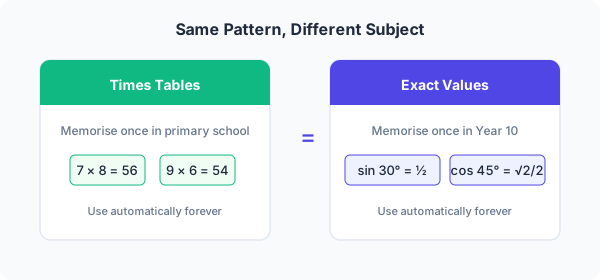
Think back to learning the 12×12 times tables. At the time, it felt repetitive and unnecessary. You were forced to memorise numbers without fully understanding why.
Fast forward to now and you probably don't even realise you're using them.
Exact values play the same role in trigonometry. Once memorised, they quietly work in the background while you focus on the actual problem.
The Building Blocks of Trigonometry
As you move through secondary maths, especially from Year 10 into Years 11 and 12 Methods, you will encounter Circular Functions such as sine, cosine, and tangent. These functions are rarely used on their own. Instead, they appear in equations, identities, graphs, and later, calculus.
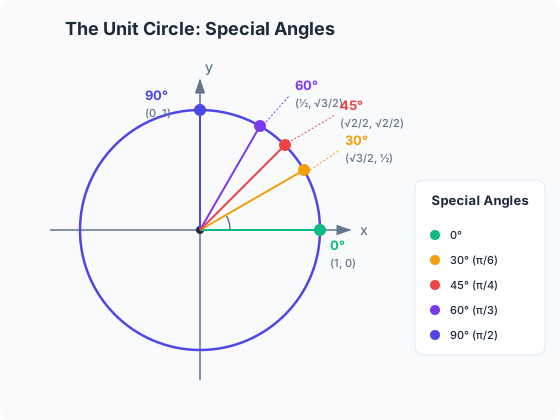
Despite all this complexity, everything is built on a surprisingly small set of core angles between 0° and 90°:
- 0°
- 30°
- 45°
- 60°
- 90°
These are known as special angles. I've been tutoring maths for a long time, the best way to explain this to students is to think of these angles as sitting in the "memorisation zone." Learn these once, and you reuse them forever.
Small Effort, Big Payoff
Here's the fun part: memorising just five angles gives you access to many more.
Angles like 120°, 135°, 150°, 225°, and even negative angles all reduce back to the same exact values using reference angles and symmetry. It's like learning five passwords that somehow unlock the entire system.
Just a quick disclaimer, Exact Values help speed up your tech-free questions. For tech-active questions, you'll most commonly be dealing with decimal answers, that's a different story.
Which Exams Require Exact Values?
Exact values aren't just a nice-to-have. They're explicitly required in most secondary and pre-university maths curricula worldwide:
- GCSE Higher Tier (UK) — AQA, Edexcel, and OCR all require exact values for sin, cos, and tan of 0°, 30°, 45°, 60°, and 90°. They appear in Paper 2 and Paper 3. See our GCSE Exact Trig Values revision guide.
- VCE Mathematical Methods (Australia) — Exact values are essential for tech-free exams (Exam 1) and heavily tested in circular functions, identities, and calculus.
- HSC Mathematics Advanced (Australia) — Required for the non-calculator sections and trigonometric proofs.
- IB Mathematics (International) — Both Analysis and Applications courses expect fluency with exact values.
- AP Calculus / Pre-Calculus (US) — The unit circle and exact values form the foundation of trigonometric calculus. See our Unit Circle Guide.
In every one of these exams, knowing exact values by heart saves time and earns marks. In non-calculator papers especially, there is simply no alternative.
The Exact Values You Need to Know
Here is the complete set of exact values for the five special angles. If you want a deeper dive, check out our full Exact Values Table including extended angles.
| Angle | 0° | 30° | 45° | 60° | 90° |
|---|---|---|---|---|---|
| sin | 0 | ½ | √2/2 | √3/2 | 1 |
| cos | 1 | √3/2 | √2/2 | ½ | 0 |
| tan | 0 | √3/3 | 1 | √3 | undefined |
Notice the pattern: the sin values read 0, ½, √2/2, √3/2, 1 — and the cos values are the same sequence in reverse. Once you spot this, you only need to remember one row. Learn more memory tricks in our How to Remember Exact Values guide.
Common Mistakes to Avoid
After tutoring hundreds of students, I see the same mistakes come up again and again:
- Swapping sin 30° and sin 60° — sin 30° = ½ and sin 60° = √3/2. Many students mix these up. Remember: bigger angle, bigger sine (in the first quadrant).
- Forgetting tan 90° is undefined — cos 90° = 0, so tan 90° = sin 90° / cos 90° = 1/0, which is undefined. This catches people off guard in exams.
- Writing decimals instead of exact values — If a question says "find the exact value," writing 0.866 instead of √3/2 will lose you marks, even if the number is correct.
- Getting confused by radians — 30° = π/6, 45° = π/4, 60° = π/3. In later years, questions will use radians exclusively, so learn both representations early.
Speed, Accuracy, and Fewer Headaches
When exact values are memorised:
- You solve problems faster
- You make fewer algebraic errors
- You spend less time second-guessing yourself
- Exams feel more manageable
Instead of stopping mid-question to work out basic values, your brain can focus on strategy and method — which is where marks are actually earned.
A Head Start That Compounds
If you memorise exact values in Year 10, you will notice a clear advantage in Years 11 and 12 Methods. Trigonometric equations, identities, graphs, and calculus applications become far less intimidating when the fundamentals are automatic.
In short, memorising exact values is not about rote learning for its own sake. It is about building a mental toolkit that makes higher-level mathematics faster, cleaner, and more confident. Just like times tables once did.
Ready to Start?
The best way to memorise exact values is through active recall — testing yourself repeatedly with increasing intervals. That's exactly what our quiz does. It uses a custom maths keyboard so you can type exact values like √3/2 naturally, and tracks your streak to keep you motivated.
The future you will thank you for memorising Exact Values. Now go and play this game!
Start Practising Now